Honest picks from real parents
What travel stroller do you actually need?
Short answer: it depends more on your baby’s age than on where you’re going. Under about a year, we’d get a car seat stroller like the Doona: it’s your stroller and your taxi car seat in one. After that, a cheap, light buggy does the job almost everywhere, unless cobblestones are on the menu.
Updated October 2026 · written on the road in Bangkok
What we use now
Why we travel with a Doona
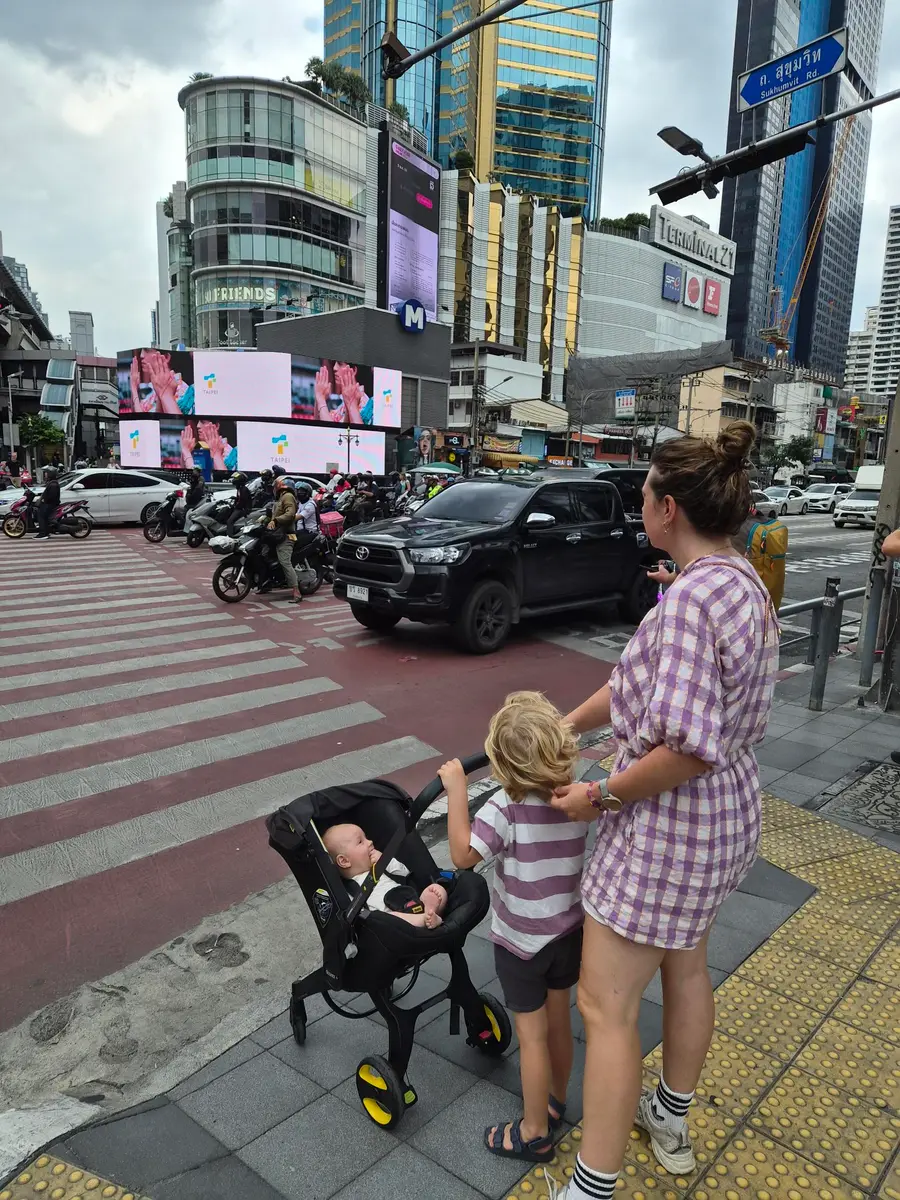
This year we bought a second-hand Doona, and it changed how we travel with our 6-month-old. It’s an infant car seat with wheels that fold out from underneath, so the same seat is the stroller on the pavement and the car seat in the taxi.
That’s the part that sold us. In many cities, taxis and Grab or Uber cars don’t come with a baby seat. With the Doona we never have to choose between having a stroller and having a safe ride: we walk, and when it’s time for a taxi the wheels fold away and the seat goes on the back seat with the car’s own belt. No base, no second bulky thing to drag along. Very convenient, very practical.
It’s not perfect, and it’s not cheap new. Here’s the honest version.
What it does well
- Taxis without the base. The seat installs with the car’s own seat belt, so any taxi with a working back-seat belt will do. Practise once at home with the manual.
- Plane-ready. It’s certified for use on aircraft (FAA-approved in the US) if your baby has their own seat. On a lap-baby ticket, you gate-check it.
- One thing instead of two. No car seat to rent, borrow or check in, and no stroller to fold in the rain while the driver waits.
Worth knowing before you buy
- Heavy to lift. The seat alone is about 6.5 kg, plus your baby. Pushing is easy; carrying it up a metro staircase isn’t.
- A one-year thing. Outgrown at 13 kg or 85 cm (European models), usually around the first birthday.
- No basket. There’s a snap-on bag accessory; otherwise, it’s a backpack.
- Not for all day. Your baby rides in a car seat position, and Doona says it isn’t meant for the whole day. Plan breaks out of the seat; a carrier is the perfect sidekick.
- Small wheels. Fine on pavements and in malls, not made for rough ground or long cobblestone stretches.
- Back seat only. Never on a front seat with an active airbag.
Which Doona?
- Doona+
- The original, and the one we have (bought second-hand). Older European safety standard (R44).
- Doona i
- The i-Size (R129) version for babies 40–85 cm. Around €530 new in Europe.
- Doona X
- The newest: three recline positions, shock absorbers and a bigger canopy. $850 at its US launch in July 2026.
All three take babies up to 13 kg. Check the label for your version’s exact limits.
Buying second-hand, like we did
To be fair: Doona, like every car seat maker, advises against buying a used car seat, because crash damage isn’t always visible. If you go second-hand anyway, these are the checks that matter:
- Buy from someone who can tell you its history, and walk away if it has ever been in a car accident.
- Find the manufacture date on the sticker under the seat. Doona says to stop using it 6 years after that date.
- Check that the harness, buckle and wheel release work smoothly, and that the manual and all parts are there.
- Check the label matches where you’ll use it (European R44 or R129, or the US version).
Once they outgrow it
After the Doona: keep it light and cheap
Here’s something most stroller review sites won’t tell you: you probably don’t need an expensive travel stroller. Our own buggy is a second-hand Hamilton, a Dutch budget brand. It’s light, folds small and survives gate check, and if it gets a dent, we don’t lose sleep over it.
Where you’re going matters more than the brand. Pushing a cheap stroller over Rome’s cobblestones or up Lisbon’s hills is a different story. So: start cheap, and upgrade only if your destination asks for it.
If you want to keep it simple
Summer 3Dlite+
≈ $130 · 14 lb (6.4 kg) · carry strap · 6 months to 5 years
The one we suggest to most friends. About $130 and 14 lb, with a carry strap for airports and a recline for naps on the go. You’ll feel every bump on rough ground, but that’s the deal with a cheap travel buggy: use it, bash it, don’t stress about it.
If you fly a lot
Joolz Aer2
≈ $550 / £440 · 6.5 kg · one-hand fold · cabin size · from birth
If you fly several times a year, this is the upgrade that earns its price. The Aer2 replaced the Aer+ we used to recommend. It has the same cabin-size fold (IATA-compliant, but check your airline), now with a one-hand, one-second fold and a lie-flat recline so it works from birth. A travel pouch is in the box.
It’s a Dutch brand, like us.
If cobblestones are on the itinerary
Bugaboo Butterfly 2
≈ $580 · 7.3 kg · full suspension · cabin size
European old towns are gorgeous, and brutal on strollers. The Butterfly 2 is the travel stroller we’d trust there: full suspension, bigger front wheels than the original Butterfly, and still a cabin-size fold. Build quality is classic Bugaboo, so it will see you through more than one kid.
Bonus: the long-haul flight hack
Stokke JetKids BedBox
From ≈ $250 · ride-on suitcase + in-flight leg rest
Not a stroller, but if you’re flying long-haul with a toddler, you should know it exists: a ride-on suitcase your kid scoots through the airport on, with a lid that turns their plane seat into a little bed. Not every airline allows it on board, so check your airline’s rules before you buy.
Before you buy anything
Check your destination first
Your destination decides more than your stroller does. Our 300+ city guides tell you whether you need suspension, whether you can skip the stroller altogether, and what to expect on the ground.
Good questions
Travelling with a Doona: FAQ
Can you use a Doona in a taxi?
Yes. The Doona installs with the car’s own seat belt, no base needed, so it works in taxis, Grab and Uber. Put it on the back seat facing backwards, route the belt exactly as the manual shows for your model (on European models the shoulder part goes around the back of the seat) and make sure it’s tight. Never put it on a front seat with an active airbag.
Can you take a Doona on a plane?
Yes. It’s certified for use on aircraft (FAA-approved in the US) and goes rear-facing on a plane seat, so your baby needs their own seat; tell the airline in advance. If your baby flies on your lap, gate-check the Doona rather than putting it in the hold.
How long can you use a Doona?
Until your baby reaches 13 kg or 85 cm on European models (35 lb or 32 inches on the US version), whichever comes first. For most babies that’s somewhere around their first birthday.
Is a second-hand Doona safe?
Doona advises against buying any used car seat, because crash damage isn’t always visible. If you buy second-hand anyway, only buy one whose history you trust and that has never been in an accident, and check the manufacture date on the sticker: Doona says to stop using the seat 6 years after that date.
Do I need an expensive travel stroller?
Usually not. A light, cheap buggy works in most cities. Spend more only if you fly a lot (a cabin-size fold like the Joolz Aer2) or you’re heading somewhere with cobblestones and hills (suspension, like the Bugaboo Butterfly 2).